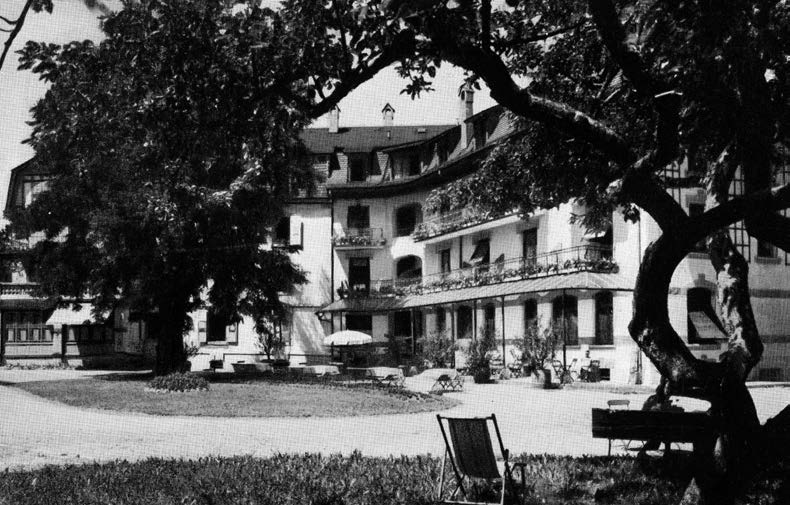
History of Hôtel La Prairie
Cities often have a symbolic building. A kind of icon. A reference that is sometimes more sentimental than aesthetic. A place linked to significant personalities — or that has become so. Also to events. Hôtel La Prairie is all of this at once.
Admittedly, “La Prairie” has not always experienced easy times, but it has always been able to exist thanks to the determination, commitment and above all the passion of three personalities: Otto Rohrer, Charles Decker and Jean-Claude Vagnières. Three businessmen with no hotel training who, in turn, loved this place and made it one of the jewels of the region.
Throughout history, the thermal spring of Yverdon has played an important role in the tourist and economic activities of this small provincial town, well located on the Swiss plateau. The evolution of La Prairie is closely linked to that of thermalism.
1840
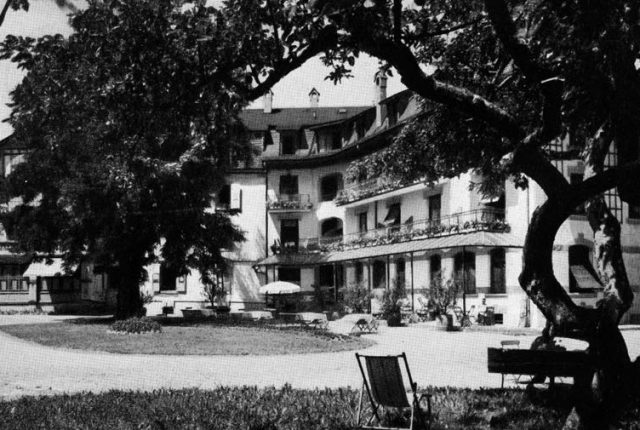
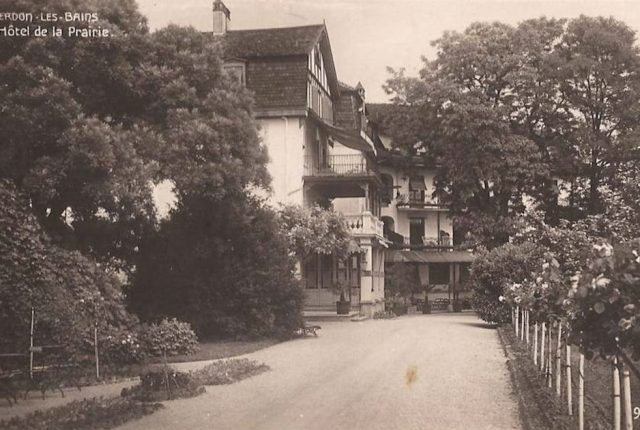
As not all spa guests could afford a stay at the hotel, in 1840 a boarding house, the first building of La Prairie, was built nearby.
During this entire period, Pension Peytermann (La Prairie) lived through crises and revivals, in the shadow or in the sunshine of the baths.
1899
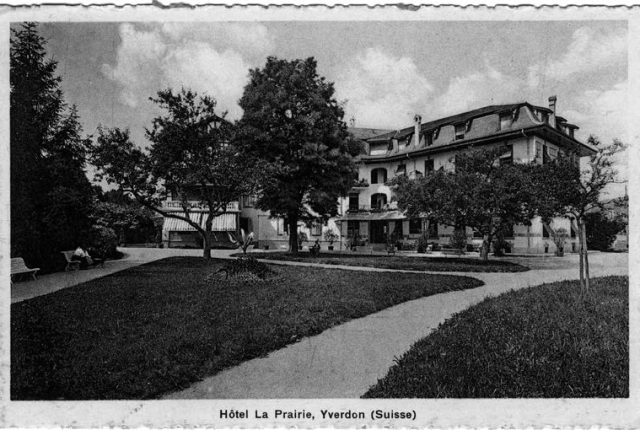
La Prairie (Pension Peytermann) retained this status until the arrival of a particularly dynamic new owner, Otto Rohrer, who wanted to restore splendour to the place. He was the first to perceive the potential offered by the 62,000 m² park surrounding the original building.
1903
Discovery of the La Prairie mineral spring, then called Yverdon water, which would later become Arkina.
1905-1910
Otto Rohrer aimed to transform this boarding house into a true hotel. It was enlarged between 1905 and 1910, intended for a more affluent clientele.
1914-1918
The Great War (1914–1918) destroyed the European economy and thermalism was severely affected. Hôtel des Bains was threatened with disappearance.
1921
Puzant Masraff (an Armenian businessman) acquired half of Otto Rohrer’s property in 1921 and developed the La Prairie spring, renamed Arkina, after a famous spring in Armenia.
1932
Closure of Hôtel des Bains in 1932. La Prairie became the only establishment available to spa guests coming to the Yverdon Baths.
1939-1945
Although it welcomed few tourists during the great global conflict that devastated Europe, Hôtel La Prairie accommodated many soldiers and later refugees.
If La Prairie had long lived in the wake of the Baths, things would be different after the war. At the end of the conflict, the establishment was in a sad state.
Despite the efforts of Otto Rohrer’s successors, his family was unable to gather the necessary means to renovate the hotel.
1946
It was under these circumstances that Charles Decker bought the hotel in 1948. It became the place everyone talked about — the place where people passed through, dined and enjoyed themselves, the meeting point of Yverdon’s high society, but also a place from which no one was excluded.
Charles Decker hired André and Eva Curchod. André in the kitchen and his wife Eva at reception — a couple inseparable from the hotel’s longest prosperous period.
1974
Jean-Paul Curchod took over the operation of La Prairie until the end of 1982.
Afterwards, Charles Decker (who died in 2004), then his heirs, entrusted the management to several successive operators, with varying degrees of success.
2014
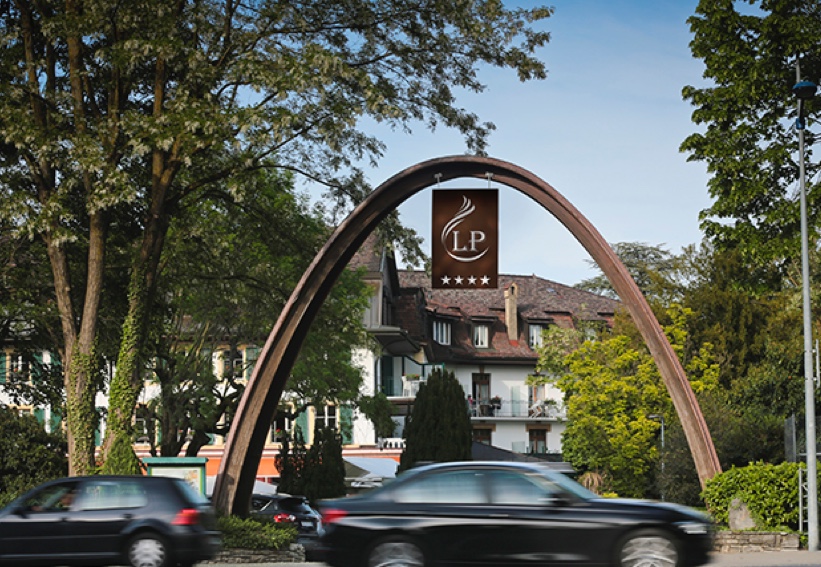
As the sky over this jewel of hospitality was turning grey, Jean-Claude Vagnières took over the operation of Hôtel La Prairie and purchased it in early 2015.
He ensured a smooth transition with the existing staff, refined his strategy and prepared major renovation works aimed at bringing this historic establishment to a level never reached before.
One can speak of a true reconstruction of a large part of the hotel.
It now houses air-conditioned luxury rooms with spacious bathrooms, meeting rooms equipped with all technical facilities, and bright openings onto the park.
2024
In May 2024, the Michoud family, already owners of Hôtel du Théâtre, joined forces with investor Marcus Weber to take over Hôtel La Prairie in Yverdon-les-Bains. Driven by a family and local vision, this acquisition promises a new momentum for this emblematic establishment, combining tradition, elegance and dynamism.